
How to Start Using the HomeFlow Method for Home Management
Using these simple steps, you can set up your HomeFlow system quickly and easily.
Materials
To begin using HomeFlow, we are going to keep it SIMPLE. Index cards and 3-4 dividers is all you'll need.
Any size of index card works fine. When in doubt, 4x6 is great. It is a good size for task cards, especially if you'd like to have space to jot down what type of cleaner you use for each task, or expectations for what the space will look like when you're finished. 4x6 is also a good size for daily reference lists.
Eventually, you might like to upgrade your daily reference lists to something tactile, like a clip list (using binder clips and firm cardboard).
But before we go crazy with the craft supplies, let's make a prototype and get to know your brain a little better.
The only other thing you need is a way to display your cards. Acrylic postcard holders work great to keep things visible, or if you prefer something more discreet, an upcycled recipe box keeps everything in one spot.
Baby Step 1: Daily Reference List
Take a mental snapshot of the way your house is right now - whether it's pristine or looks like an extension of the local landfill.
Between today and tomorrow, you'll use the house.
People will make food and eat it,
Come and go to appointments and activities,
Get ready for bed,
And wake up tomorrow to get started on another day.
By this time tomorrow, if you don't do something to slow the growing messes, your house will be messier.
But what if you could freeze the mess so it didn't grow?
Baby Step 1: Creating a daily reference list
Identify what small, doable things you could do each day, not to cure your house of chaos, but to stop the mess from growing. What is the minimum amount of housework that you could do, if all you wanted was to keep the house basically the same over a 24 hour span?
To this list, add basic hygiene (like a reminder to brush your teeth) and safety measures (like locking the door).
This is your daily reference list!
Baby Step 2: Making it Easier
Let's think a little more deeply about what's on your Daily Reference List.
How could you make those things ridiculously easy to manage?
You know yourself and your home best, but if you'd like some help, here are some ideas to get you started:
- Splitting the daily list into a morning list and an evening list
- Keeping a "tidy later" basket in each room, or near where clutter accumulates, so you don't have to walk around picking up individual items
- Strategically position laundry hampers and trash cans to be easy to reach
- Reduce the number of things you have to manage by boxing them up for storage or giving them away
- Keeping supplies within arm's reach of where they're used
- Explicitly delegate certain tasks to certain members of the household
- Make your entryway "drop zone" more functional and easy to use, with hooks and open-top bins/trays for collecting clutter
- Empty the dishwasher (or drying rack) before dishes start getting used during the day, so that dishes can skip the sink pile
Baby Step 2: Make a short list of things you can set in place once, that will help make daily home management easier for months and years into the future. This doesn't have to be an exhaustive list; just what feels manageable this week.
Then write your daily reference list "pretty-like," and post it where you'll see it throughout the day. If you'd like to create a clip list or plastic slider checklist, you can do that now.
Baby Step 3: Real Priorities
Creating a list is nice, but research shows that we're most likely to keep our new goals if we are honest with ourselves about how they would fit into our day, with everything else that needs our attention.
Keeping a clean house isn't the only important thing on your plate right now!
What else comes up during the day that might get in the way of your daily list(s)?
Maybe spills will happen by accident; will you clean those up before or after your daily list is finished?
What about if the kitchen garbage can fills in the middle of the afternoon?
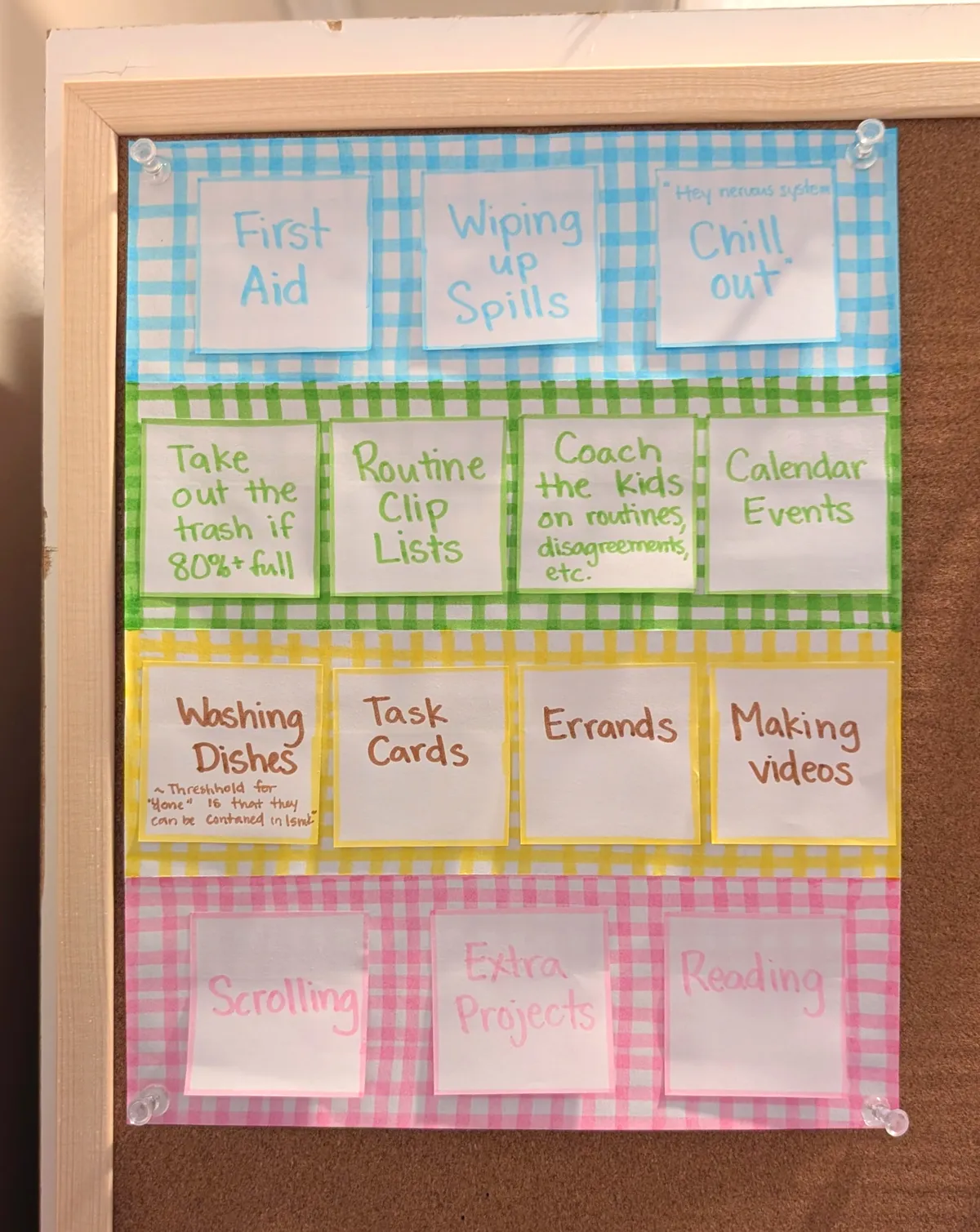
Things like calendar events, resting, housework (beyond what's on the daily list), hobbies, errands, hanging out with friends... all of these things deserve your attention. It's just that they can't all have your attention first.
Baby Step 3: Jot down your honest thoughts about how your priorities compare with each other. How do they compare with the daily reference list you made?
You might make a tier chart (example pictured, right) to show your priorities visually.
You'll add to this list in Baby Step 6, so don't hang it on the wall yet!
Baby Step 4: Weekly & Monthly Tasks
Now that we have daily reminders out of the way, there are two types of home-related tasks:
Things that need to happen on a specific day;
And things that could happen on any day, as long as they happen regularly.
Baby Step 4 is for brainstorming housework tasks that are necessary and reasonable, and then making space for them in your system.
Here is a generic brainstorm to get you started. Feel free to adjust the details to what your home actually needs, and what feels doable to you.
Probably Weekly-ish housework:
Taking dumpster to the street for pickup (calendar)
Bathroom wipe-down (index card)
Kitchen wipe-down (index card)
Sweeping/vacuuming (index card)
Mopping (index card)
Changing the sheets (index card)
Deleting as many emails as possible; adding things from emails to a calendar or one-time to-do list as needed (index card)
Opening mail; adding things from mail to a calendar or one-time to-do list as needed (index card)
Checking the one-time to-do list and working through it (index card)
Freshening up the front entryway (index card, or possibly calendar if you regularly have houseguests on a certain day of the week)
Working on a tiny decluttering/organizing goal (index card)
Probably Monthly-ish housework:
Paying rent or mortgage (calendar)
Dusting (index card)
Wiping off high-touch surfaces (grimy corners of walls, handrails, etc.) (index card)
Running a tub clean cycle on the laundry machine (index card)
Detailing the dishwasher (index card)
Refrigerator cleanout (index card)
Microwave cleanout (index card)
Tub/shower scrubdown (index card)
Saving photos / deleting blurry ones (index card)
Taking donations to the dropoff center (index card)
Vacuuming couch/upholstery (index card)
Baby Step 5: Making Task Cards Easier
You know the drill by now.
Go through all the tasks you just brainstormed, one at a time, and answer this question:
If I had to get up and do this task right now, would it feel manageable?
Or would I rather start a DIY remodeling project in the living room?
Ha!
Let's use Baby Step 5 to make housework easier. Add to your one-time tasks' to-do list, anything you can change about your home to make these tasks easier to start.
All the ideas from Baby Step 2 still apply: strategically placed hampers and cleaning supplies, delegating, decluttering, and the rest.
Here are a few more ideas, if you'd like them:
Part of what makes housework feel overwhelming is the fact that, a lot of times, we weren't taught how to do them. Or if we were taught, all the cleaning supplies were chosen for us. If this is the case, YouTube tutorials and goblintools.ai can break things down into tiny steps, so you know exactly where you can start.
If a chronic illness limits your your energy or mobility, try looking for mobility aids, or invite a good-natured neighborhood teenager to help you out for a few dollars a week.
If you struggle to figure out what could possibly make a task easier, social media communities like r/cleaningtips or Facebook's Neurodivergent Cleaning Crew can help you figure out solutions that might work for you.
In a few weeks, as you work through the cards, you might run into one that you didn't expect to feel as unmanageable as it does in the moment. It's never too late to make adjustments!
Baby Step 6: Deciding When
Remember your notes from Baby Step 3, where you organized your priorities?
There's just one more addition to make in Baby Step 6: where the task cards and scheduled to-dos fit in.
How do you know when to start?
How do you decide that you're done?
Once you add task cards to your priority stack, you're ready to put your HomeFlow system in action!
Ready to go!
Now that you've finished all six baby steps, you are ready to get started!
Remember, this is a prototype. Any time you need to adjust things, that decision is totally in your court. You don't need to feel obligated to live by your current hypothesis until the end of time. Make changes as you go. Keep it simple. This is designed to serve you.